


- About
- Programs
- Campus Life
- Career Services
- Admissions
- News & Events
- Alumni


Famous Chefs: 18 Culinary Icons Who Shaped the World (2026)
Discover the 18 most famous chefs in the world, from Auguste Escoffier to René Redzepi. See how each transformed cuisine, restaurants, and food culture.

Key Takeaways
- Famous chefs influence how people cook, eat, and think about food through their restaurants, techniques, cookbooks, media work, and wider cultural influence.
- Technical innovators include Auguste Escoffier, Alain Ducasse, and Joël Robuchon, who changed kitchen systems, fine dining, and Michelin-starred excellence.
- Boundary-breakers such as Ferran Adrià, Heston Blumenthal, and René Redzepi expanded what modern cuisine could look, taste, and feel like.
- Popularizers, including Julia Child, Gordon Ramsay, and Wolfgang Puck, brought professional cooking into homes, screens, and everyday food culture worldwide.
Famous chefs are the ones who change how people cook, eat, and think about food. Their influence can begin in a restaurant kitchen, a cookbook, a television studio, or a completely new way of looking at ingredients. From Auguste Escoffier's brigade system to René Redzepi's modern Nordic cuisine, the most famous chefs in history did more than master their craft. They changed the direction of it.
For anyone who wants to become a chef, these stories can be useful because they show how many different routes a culinary career can take. Some chefs became known through fine dining. Others changed home cooking, restaurant culture, food television, sustainability, education, or the way chefs connect food to place, memory, and creativity.
What Makes a Chef Famous?
Chefs become famous through a mix of culinary innovation, restaurant recognition, media presence, influential kitchens, and cultural impact. Some introduce new techniques, cuisines, or philosophies. Others publish cookbooks, appear on television, build restaurants where future chefs train, or use food to influence conversations around sustainability, education, and advocacy.
Michelin recognition remains one of the strongest markers of restaurant influence, with stars awarded for outstanding cooking based on consistent criteria.
18 Most Famous Chefs in the World
Throughout history, certain chefs have transformed the culinary world by introducing new techniques, redefining restaurant service, changing how people cook at home, and influencing how society thinks about food. The chefs below became famous for different reasons, but each left a mark that continues to guide cooks, restaurants, and food lovers around the world.
Auguste Escoffier
Auguste Escoffier is hailed as one of the most famous French chefs of all time and even praised as "the king of chefs and chef of kings."
His most notable innovation was the introduction of the "brigade de cuisine," a hierarchical system inspired by his military experience. This structure introduced a new level of order and efficiency to professional kitchens, assigning specific roles to staff members and streamlining operations.
Escoffier's collaboration with César Ritz, the world-renowned hotelier, revolutionized luxury dining at renowned establishments such as the Savoy Hotel in London and later at the Ritz Hotel in Paris.
In honor of Escoffier's legacy, the Ritz Paris established the École Ritz Escoffier, a culinary school dedicated to upholding the standards of excellence he championed. Students from the Culinary Arts Academy Switzerland (CAAS) have had the privilege of attending intensive programs at this school.
Julia Child
Julia Carolyn Child is one of the most famous female chefs and TV chefs in American history. She influenced American cuisine by demystifying French cooking for the everyday cook. For four decades, through her award-winning cookbooks and acclaimed television programs, she presented an approachable version of sophisticated French cooking to her eager audience.
In recognition of her monumental contributions to culinary arts and education, she was awarded the U.S. Presidential Medal of Freedom. The medal was a recognition of her role in shaping America's dining scene.
Anton Mosimann


Start Your Culinary Journey
Learn the art of cooking in a world-class environment
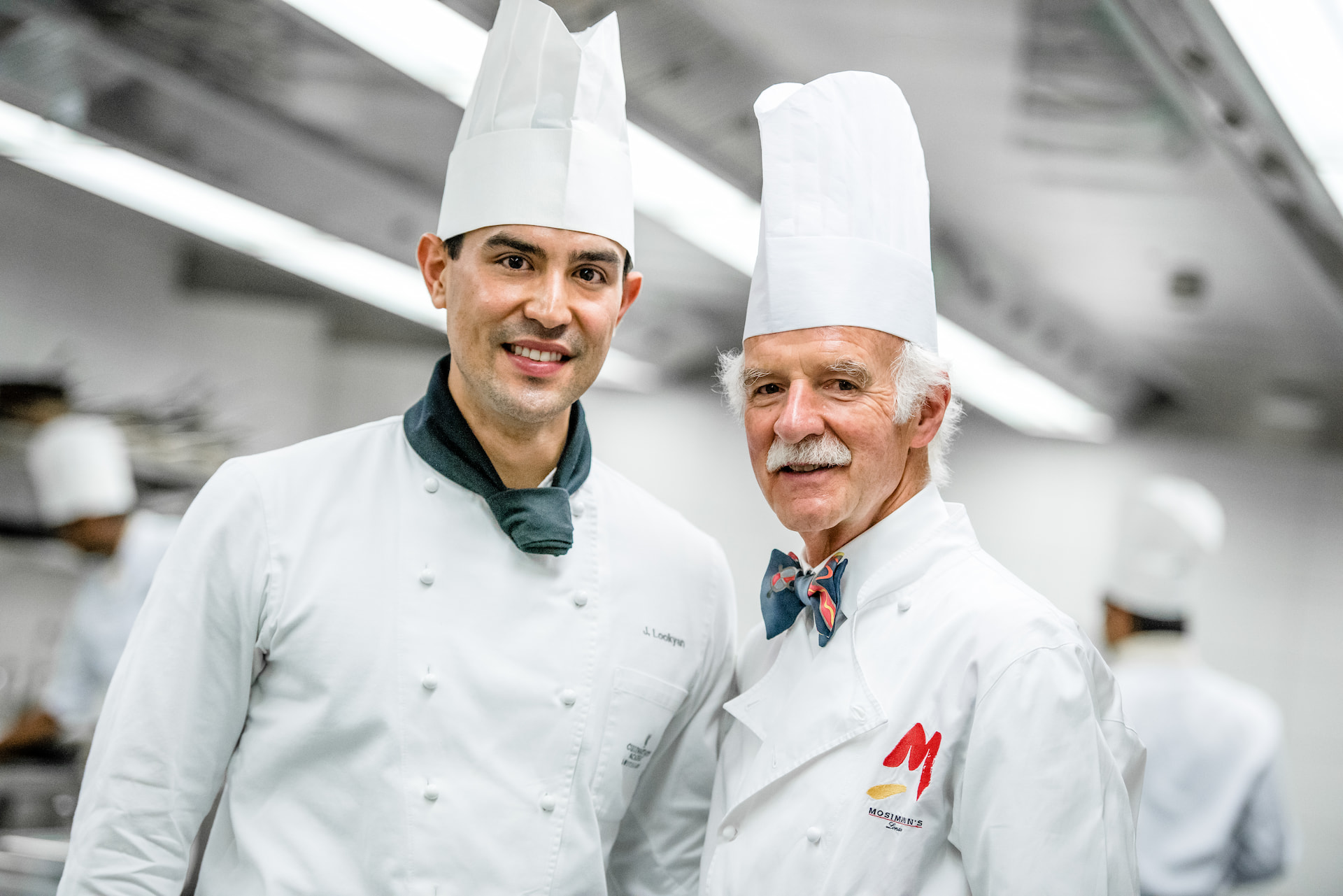
Anton Mosimann is a paragon of culinary innovation and excellence, particularly esteemed by the Royal Family of England, the Swiss gastronomic community, and Culinary Arts Academy Switzerland, where he is currently the Honorary Dean. As the pioneer of "Cuisine Naturelle," Mosimann emphasized healthy cooking without additives, focusing on natural flavors and fresh ingredients.
His tenure as Maitre Chef des Cuisines at The Dorchester Hotel in London was marked by the attainment of two Michelin stars. He later founded Mosimann's Club, one of the world's most prestigious dining clubs, and provided catering services to the Royal Family of England.
Acknowledging his contributions, Mosimann was appointed an Officer of the Order of the British Empire (OBE) for his services to the culinary arts and was awarded the Swiss Culinary Merit of Honor as a lead culinary icon of Switzerland.
Today, Chef Mosimann's legacy continues at Culinary Arts Academy Switzerland through the Swiss Education Group partnership. Students can explore his personal collection of rare cookbooks, photos, medals, recipes, and historic menus at the Le Bouveret campus, while the Anton Mosimann Award recognizes students who excel in culinary heritage research.
Gordon Ramsay
Gordon Ramsay is arguably the most famous TV chef in the world, known for combining fine-dining standards with a powerful media presence. His sharp wit and unforgettable moments on hit shows like "Hell's Kitchen" and "MasterChef" have made him a media sensation and social media favorite.
However, a chef with exceptional skill and discipline is hidden behind the viral videos and colorful language. Ramsay has built a global culinary empire. As of 2026, he currently holds 9 Michelin stars across his restaurant empire globally. Over the course of his career, however, he has been awarded a total of 17.
Alain Ducasse
Alain Ducasse is one of the most revered figures in modern gastronomy, holding more Michelin stars than almost any chef in the world. He made history by becoming the first chef to own restaurants carrying three Michelin stars in three different cities: Paris, Monaco, and London.
Ducasse's focus on excellence, innovation, and sustainability has inspired generations of chefs around the world. For many, meeting him is a dream come true.
One such inspiring moment happened for CAAS alumnus and now-chef Kimani Kiarie, who, during his studies at CAAS, secured an internship at the Dorchester Collection's Le Meurice in Paris through the International Recruitment Forum. It was there that he had the incredible opportunity to be introduced to Alain Ducasse, a reminder of the doors that open with hard work and the right guidance.
Paul Bocuse
Known as the "pope of gastronomy," Bocuse is hailed as one of the most important figures in contemporary French cooking. He was a leading figure in shifting focus from heavy, traditional French cooking to lighter and more delicate dishes. His philosophy emphasized simplicity and seasonal produce.
He established the Bocuse d'Or, one of the most prestigious and demanding international culinary competitions, showcasing the world's best chefs and encouraging innovation. His contributions were recognized globally, earning him numerous honors, including the title of "Chef of the Century" by the Culinary Institute of America.
Ferran Adrià
The genius behind El Bulli, a restaurant that was once regarded as the greatest in the world, is Ferran Adrià. He pioneered molecular gastronomy by transforming familiar flavors into new experiences through unexpected textures and deconstructed dishes.
Under his leadership, El Bulli held three Michelin stars for years and earned the title of World's Best Restaurant five times from The Restaurant Magazine. In recognition of his decade-long influence on culinary innovation, Adrià was named "Chef of the Decade" in 2010.
Marco Pierre White
Marco Pierre White is renowned as the youngest chef to ever be awarded three Michelin stars at just 33. He influenced and mentored some of today's most famous chefs, including Gordon Ramsay and Heston Blumenthal.
Known for his intense and exacting presence in the kitchen, Marco eventually made headlines for returning his Michelin stars and stepping away from the stove. However, he still remains involved in the culinary world because, as he stated:
Even though I am not behind the stove anymore, it doesn't mean I can't share my three-star knowledge or my three-star philosophy.
Thomas Keller
From the most renowned kitchens in the world to pop culture, Thomas Keller has had a significant impact. He was the culinary consultant behind "Ratatouille," one of Pixar's most beloved films. His involvement was only fitting, as Keller is known for elevating the art of cooking to its highest level.
He is the acclaimed owner of The French Laundry in California and Per Se in New York, both three-Michelin-starred restaurants celebrated for their impeccable technique and perfectionism. His approach emphasizes culinary excellence, discipline, refinement, and respect for the craft.
Heston Blumenthal
Alongside Adrià, Heston Blumenthal stands as one of the great pioneers of molecular gastronomy. Blumenthal is known for his experimental approach as he transforms dining into a multisensory experience, where sound, scent, and texture are as important as taste.
Amazingly, he is self-taught, but his restaurants—including The Fat Duck, which was named the best restaurant in the world; Dinner by Heston Blumenthal; and The Hinds Head—have received six Michelin stars.
Heston also enriches culinary knowledge through his dedication to food pairing theory. He explores why certain flavors, like caviar and white chocolate, work so well together.
Massimo Bottura
Massimo Bottura, chef-owner of Osteria Francescana in Modena, Italy, blends traditional Italian flavors with bold, contemporary techniques. His work has earned him worldwide acclaim, with Osteria Francescana repeatedly ranking among the world's best restaurants.
He uses his global platform to promote sustainability, reduce food waste, and protect biodiversity. In 2016, together with Lara Gilmore, his wife, he founded “Food for Soul,” a nonprofit that transforms surplus food into nourishing meals for those in need.
Wolfgang Puck
Wolfgang Puck is widely recognized for popularizing fusion cuisine by combining elements from various culinary traditions. In many of his dishes, he blends classic French techniques with fresh Californian ingredients, Asian flavors, and innovative twists.
One of his signature dishes is smoked salmon pizza. This dish merges traditional Italian pizza-making techniques with high-quality ingredients and adds a touch of luxury through the inclusion of salmon and crème fraîche.
Joël Robuchon
The late Joël Robuchon holds the record for the most Michelin stars ever awarded to a chef, with 32 stars to his name. He revolutionized fine dining with dishes that emphasized quality ingredients and impeccable technique.
Perhaps his most iconic creation is the legendary potato purée recipe, often hailed as the smoothest and richest mashed potatoes ever made. With nearly equal parts butter and potato, whipped to silky perfection, this purée became a symbol of culinary excellence.
"I owe everything to these mashed potatoes," Robuchon once said, acknowledging the power of mastering and revolutionizing even the simplest dishes.
Alice Waters
Alice Waters is the founder of Chez Panisse in Berkeley, California, where she transformed dining by championing organic, locally sourced ingredients long before it became mainstream.
Waters is also a celebrated author of books like "The Art of Simple Food II" and "We Are What We Eat: A Slow Food Manifesto,” both of which perfectly reflect her philosophy of simplicity and care for the environment.
Through projects like the "Edible Schoolyard Project," she has worked to educate children about healthy, sustainable food.
René Redzepi
René Redzepi is the celebrated chef and co-owner of Noma in Copenhagen. He is widely recognized for redefining Nordic cuisine by focusing on hyper-local, seasonal ingredients from the Nordic region.
Redzepi is also known for incorporating creative fermentation techniques into Nordic cuisine. His innovative, nature-inspired approach has inspired chefs globally to explore their own local ingredients and traditions in entirely new ways.
Dominique Crenn
Dominique Crenn made history as the first female chef in the United States to earn three Michelin stars at her flagship Atelier Crenn in San Francisco. Awarded its third star in 2018, Atelier Crenn placed her in a tiny global circle of chefs at the very top of the Michelin system.
"Poetic culinaria," her signature philosophy, turns tasting menus into autobiographical verse, blending French heritage and California ingredients in a way that feels as much like storytelling as fine dining. Alongside her cooking, she has become a prominent advocate for women and equity in professional kitchens.
Clare Smyth
Clare Smyth, chef‑owner of Core by Clare Smyth in London, became the first British woman to earn three Michelin stars when Core entered the 2021 Guide at the highest level.
A former head chef and chef patron at Restaurant Gordon Ramsay, she is known for precise, ingredient‑led modern British cooking that elevates humble produce with technical rigor. Alongside awards such as World's Best Female Chef 2018 and being appointed Member of the Order of the British Empire, Smyth has become a reference point for women leading kitchens at the very top of the UK fine‑dining scene.
Yoshihiro Murata
Yoshihiro Murata, third‑generation chef‑owner of the Kikunoi group in Kyoto and Tokyo, is one of Japan's most decorated chefs, with seven Michelin stars across three restaurants devoted to kaiseki cuisine. At Kikunoi Honten, Roan Kikunoi, and Akasaka Kikunoi, he has used meticulous, seasonal cooking to both preserve and modernize classical Japanese dining, while his Japanese Culinary Academy and global advocacy helped secure UNESCO recognition for washoku.
How These Chefs Shaped the Culinary World
What has made these chefs culinary legends is not only their talent in the kitchen, but the way they changed how people think about food. They left a lasting imprint through their dishes, systems, philosophies, restaurants, and the movements they helped create.
Some, like Alice Waters, Massimo Bottura, and Dominique Crenn, took their kitchens into the community to inspire change and promote sustainability. Others, like Julia Child and Thomas Keller, made fine cuisine feel more accessible, teaching generations of aspiring chefs and home cooks what a day in the life of a chef can involve: cooking, leading, teaching, creating, and constantly learning.
How to Become a Chef Like the Greats


Curiosity, commitment, and the right direction are the foundations of success in the culinary arts. Reaching the level of the chefs above takes discipline, training, mentorship, and an environment that gives creativity room to develop.
At Culinary Arts Academy Switzerland (CAAS), one of the highest-ranking culinary schools in Switzerland, students train in exactly that environment. As Chef Anton Mosimann put it, "We need good people; we need educated people, and I think Culinary Arts Academy is perfectly poised to offer young people that opportunity. I'm very impressed with all of what I have seen in the last couple of years."
CAAS offers culinary courses such as the BA in Culinary Arts and the Swiss Diploma in Culinary Arts, combining kitchen leadership, business understanding, and culinary technique. Through the Distinguished Chefs Series, students also learn from renowned chefs who share their recipes, stories, lessons, and professional experience.
Every aspiring chef deserves the chance to achieve greatness. We're here to help make that happen.
Frequently Asked Questions
Who is the most famous chef in the world?
Gordon Ramsay is often considered the most famous chef in the world because of his global television career, Michelin-starred restaurants, and international restaurant group. In fine dining, chefs such as Alain Ducasse, Joël Robuchon, and Massimo Bottura are also among the most influential.
Who is the most famous female chef in the world?
Julia Child remains one of the most famous female chefs because she changed how Americans learned French cooking through her cookbooks and television shows. Today, chefs such as Dominique Crenn, Clare Smyth, Alice Waters, and Anne-Sophie Pic are also widely recognized for their influence.
Who are the most famous French chefs?
Some of the most famous French chefs include Auguste Escoffier, Paul Bocuse, Alain Ducasse, Joël Robuchon, Dominique Crenn, and Anne-Sophie Pic. Their influence ranges from classical kitchen organization and nouvelle cuisine to Michelin-starred fine dining, modern French cooking, and culinary education.
Who is the most famous TV chef?
Gordon Ramsay is widely seen as the most famous TV chef today because of shows such as "Hell's Kitchen", "MasterChef", and "Kitchen Nightmares". Historically, Julia Child holds a similar place because "The French Chef" helped bring professional cooking instruction into American homes.
How do chefs become famous?
Chefs become famous through a mix of innovation, restaurant success, Michelin recognition, media visibility, mentorship, and cultural influence. Some change techniques or ingredients, while others build defining restaurants, publish influential books, appear on television, or lead movements around sustainability, education, and food culture.
What knives do famous chefs use?
Famous chefs use different knives depending on their training, cuisine, and kitchen style. Many rely on high-quality chef's knives, Japanese gyuto knives, paring knives, boning knives, and slicers. The best knife is usually the one that feels balanced, stays sharp, and suits the chef's daily work.
Interested in becoming a world-class chef? Learn more about Culinary Arts Academy Switzerland. Download our brochure.